
Organization
Vision
A world in which adolescent girls have the knowledge, confidence and opportunities to become agent-of-change and participate in building a fair and equitable society where social justice and gender equality thrive.
We envision girls not simply as learners or transformative leaders, but as informed citizens whose perspectives, ideas and actions can contribute meaningfully to the communities and the world around them.
Mission
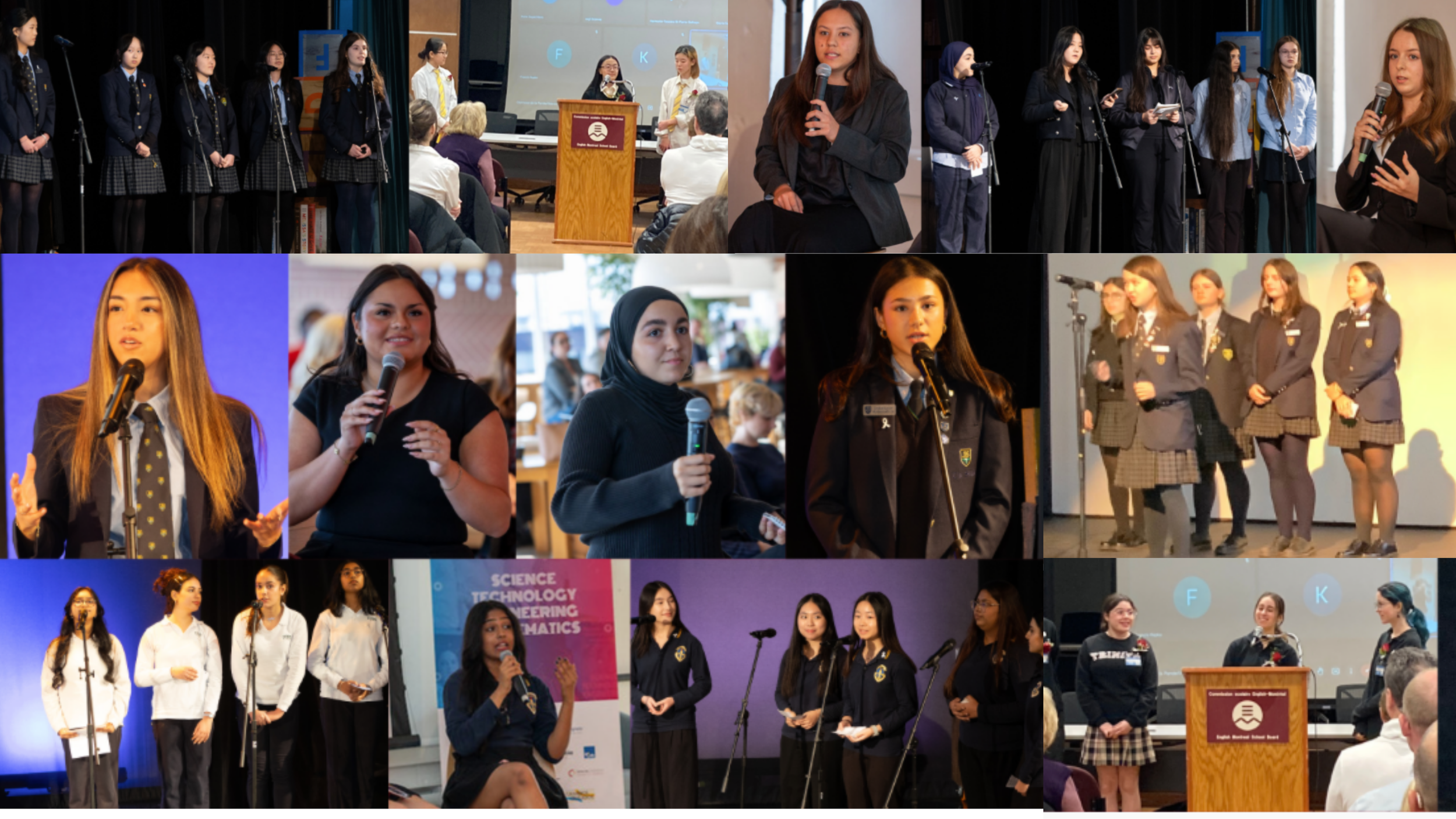
Voices of Olympia Canada (VOOC) empowers adolescent girls to become transformative leaders by creating opportunities for participants to analyze complex societal issues affecting women and girls, develop evidence-informed responses, engage with communities, and transform knowledge into responsible action.
Our Approach: From Knowledge to Responsible Action
Since 2017, VOOC has offered adolescent girls a distinctive learning experience connecting education, mentorship and community action.
Our pedagogical approach is built around four interconnected pillars:
Global Citizenship Project-Based Learning
Specialized Mentorship
Meaningful Youth Community Engagement
Promotion of a Culture of Science
Through this approach, VOOC creates an intergenerational bridge, connecting adolescent girls with experienced professionals, community leaders and decision-makers, and creating safe spaces where they can take their place in global discussions, bringing the perspectives, ideas and determination of their generation.
The United Nations 2030 Agenda for Sustainable Development provides us a broader framework for reflection and action, connecting global challenges with Canadian context and local communities’ needs.
At the heart of our approach is a simple conviction:
Knowledge is not the endpoint. It is the starting point for responsible action.
Values
Our work is grounded in gender equality, social justice, inclusion, respect, integrity, collaboration and responsible leadership.
We believe that education should develop not only knowledge, but also curiosity, critical thinking, ethical judgement and the capacity to act responsibly.
We believe in the power of mentorship, community engagement and intergenerational knowledge-sharing to help adolescent girls recognize the value of their voices and their capacity to contribute to positive change.
And we believe that empowering girls means giving them not only a voice, but also the knowledge, tools, opportunities and confidence to use that voice responsibly.

Brief history
Voices of Olympia Canada began in Montréal in 2017 with a conviction: when adolescent girls are given the opportunity to investigate the issues shaping their world, supported by knowledge, mentorship and community engagement, they can become powerful contributors to change.
Inspired by Les Olympes de la Parole, a European school competition named in honour of Olympe de Gouges, author of the 1791 Declaration of the Rights of Woman and of the Female Citizen, Dr. Saôde Savary launched the first North American edition while serving as President of the University Women’s Club of Montreal.
From its earliest years, however, the Canadian initiative began developing an identity of its own.
Participants researched complex issues affecting women and girls, that are discussed annually at the United Nations Commission on the Status of Women (UN CSW). They examined evidence, engaged with communities and proposed solutions. Their projects addressed issues ranging from Indigenous women and technology to poverty, climate change, health, economic inclusion and gender equality.
And something important became clear: the girls did not simply want to understand the issues. They wanted to act on what they had learned.
That experience gave rise to a principle that continues to define VOOC:
Knowledge is not the endpoint. It is the starting point for responsible action.
Following growing interest from schools, the initiative expanded beyond Montréal. In 2020, Voices of Olympia Canada was established as an independent not-for-profit organization and subsequently became a registered charity with the Canada Revenue Agency (CRA), registration no. 707714739RR0001.
Over time, the educational model evolved around four pillars of excellence: Global Citizenship Project-Based Learning, Specialized Mentorship, Meaningful Youth Community Engagement and the Promotion of a Culture of Science.
Today, as VOOC approaches its tenth anniversary, the issues continue to evolve, including the opportunities and challenges created by artificial intelligence, but its purpose remains constant: to give adolescent girls the knowledge, tools, confidence and opportunities to turn learning into responsible action and leadership